'If the bee disappeared off the surface of the globe, then man would only have four years of life left. No more pollination, no more plants, no more animals, no more man.'- Einstein
I love bees. I want to feel them crawling on me- not like those videos you see of people with every inch of their bodies covered in swarms of the critters but I like to feel them dance on and off my skin tip tapping and bouncing here and there. Sadly bees only exist tentatively threatened by virus' caused by destructive agricultural practises such as the use of pesticides. We must give bees thanks for 1/3 of the food we eat. Their pollination ensures we have delicious foods- can you imagine a world without avacado? pumpkin? oranges?
There is a mobile bee hut set up outside MCA at the moment, for the In The Balance; Art for A Changing World. Apparently on Saturday (when I'll be away..boo) you can go and have a picnic and a chat about the native stingless bees and eat some pikelets with their honey. Sydney collective Makeshift (navigate around their website- it's very cool) are the food activists/artists behind it all. Read about the project here.
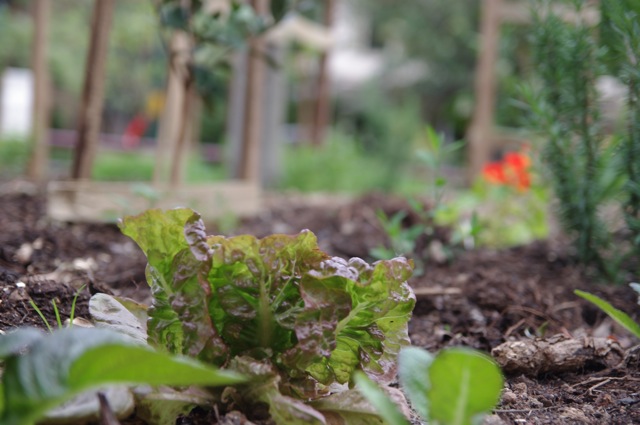
Artist as Family's artwork for MCA's In The Balance; Art for a Changing World. A living, growing, transforming "installation"- a food forest designed with permaculture principles (located outside St Michaels Anglican Church, Surry Hills). I'll say a bit more about it later, but I wanted to upload some pictures that show just how artful the experience of gardening is- well I hope it evokes that sense anyway. We certainly had a very pleasant time going from MCA in house exhibition (which will need to be revisited 4 or 5 times I think), over to The Food Forest then over to the C.O.F.A permaculture patch to spruce things up a bit.
I've been thinking a lot lately about sustainable art practice; how to still use all the pretty, interesting and workable materials out there but considering how to minimise (if not eliminate...which is difficult when not actually intending to make an ecologically themed artwork) the affect it has on the environment. I've managed to come to a lot of decisions in my personal life but haven't yet established my own rules and limits in terms of art. How can I justify the use and wastage of artworks?
The first practice I/we (the punk monk team) need to tackle is the Liquid Light Show. Liquid Light is the act of using oil, detergent/gel and coloured dyes (we currently use food dye) to make patterns that move and mutate in glass. These are put on top of overhead projectors and beamed onto spaces. Therefore, energy from electricity is needed, chemicals from the liquids which are bought and then disposed of afterwards, use of cleaning products (sprays and cloths) and large amounts of water for mixing and cleaning are used. Then there is the fact that, where we would usually walk/ride/skate to an event, with our overhead projectors and gear we must use someones vehicle to get to and from the venue.
The very easiest change can be applied to the cleaning up method. Alex and I attended a workshop a few months ago with The Watershed learning how to make our own environmentally safe cleaning products using basic and inexpensive ingredients like bicarb, vinegar, eucalyptus oil and pure soap and then using re-use spray bottles from ex- cleaning products packaging or from re-use centres like Reverse Garbage. Perhaps some microfibre cloths that do not get damaged by intensive use and dyes rather than using disposable chux/paper towel could be the next step here....
If anyone has any ideas/suggestions on what kind of dyes are of minimal effect and inexpensive or if anyone is some kind of solar power Whizz Kid and can help us work towards solar powered overheads...then WOW. The key word, inexpensive, is unfortunately important- we simply cannot afford to BUY our way into sustainability.
Baby steps.
Above is a video by a group The Joshua Light Show that we are inspired by in our liquid light experiments. We have been doing Liquid light projection art for art shows, music gigs and other events for about a year since our second Punk Monk hosted event called ALGAE RHYTHM. ALGAE RHYTHM 0.02: PSYCHOCHEMICALcurated by monks Alex and Kate which turned the then Punk Monk warehouse into an oozing rainbow cranium of melding patterns, forms and textures created by the old school overhead projectors and their wizard controllers. The night was full of mural painting, science experiments, psychedelic music and light play and we haven't looked back since.
The photo above is of Kate mixing colour at Know Your Mushrooms (Ron Mann) screening and party, an event for Possible Worlds Film Festival where we celebrated fungi, films and all forms of fun! Snapped by our good friend and brilliant photographer Susie Stavert.
(Don't forget to catch us on Wednesday @ The Annandale for a jam with psychedelic rockers Sister Jane)
It's been all about moss for a while now, however now a new lush green flora has unexpectedly come into my life. It's about to become all about Wheatgrass.
One week ago, one Alex and I wondered past At The Vanishing Point gallery (ATVP) and I recalled a facebook invite I'd gotten triggering the words interactive, ecological, tangible, DIY (words which are usually enough to attract us Punk Monks anyway) but also Wheatgrass!
Of course we were then intrigued. We wandered in to what we discovered to be the opening + artist talks. We were ushered out the back and asked if we'd like a vodka and Wheatgrass, Brendan (Director of ATVP and artist of The Phenomenology Machine 1.0) was somewhat surprised by our enthusiastic acceptance. We weren't sure what was going to happen, but boy was that a full on shot of green alcohol.
video art of natural phenomena and moving poetry text in two juxtaposed but interacting panels. Set up on the floor, like peering into a pond, moving visual haikus of light and shadow in moving leaves, cherry blossoms and water droplets accompanied by KenjiMiyazawa's poetry text which created both separation between the two.
Disturbance and interaction were the main points of discussion. The ways in which the artwork draws us in (accompanied by a zen soundscape lulling you into meditation with the artwork) and then how both elements of the work and the space creates disturbance for the viewer- this particular space encompassing light and shadow movement and noise disturbance brought in from the street. Within the work shifts in the text which move around the panel, merge with one another and turn upon themselves causing a similar disturbance in the minds eye as we attempt to follow them and draw connections with the visuals alongside it. The artist talk itself exhibited the point well, as I stared into the work and became immersed, attempting to interact with it, I was brought from my trance by snippets of spoken words of interest before the repeated gong at the beginning of the soundtrack drew me back into the work.
In the spirit of the phrase "And now for something completely different", we followed Brendan Penzer into the tiny room above the stairs towards the curious Phenomenology Machine 1.0. Barefooted, standing upon the smooth blanket of Wheatgrass bordering the room, he explained his prototype for a bigger, exciting project to be launched next year. With the mossy, fresh smell of Wheatgrass in the air, I felt a little high cramped into this room as bursts of mist were left floating in the air and golden light streamed from the phone booth like, reflective platform. It is here where you are beckoned into the dark space towards solar energised light and button activated mist. Here you are enveloped in mist and then banished into darkness once more. The ecological installation reminds us that we are in positions of action in relation to our surrounding environment.
Different interpretations and relations to the space became evident in the talks as Brendan simultaneously critiqued his own work. Some related to the space with confusion and fear from the darkness and the "unknown" used as a luring force- I personally believe confusion is a very important aspect of discovering a work. This work in particular was about relating to an environment- confusion is necessary because to overcome it you must take an action, thus activating the artwork. In relation to our natural living environment, more people should be lured by the sometimes frightening and confusing aspects of what is happening around us, and prompted to do something about it.
Penzer is now developing a mobile ecological art gallery which will begin in ATVP's courtyard and then begin its movement into other spaces. In the spirit of DIY renewable energy and viewer interactivity, this could be one of the most intriguing innovations to come out of Sydney in 2010.
Finally, to top of a beautiful spontaneous Saturday afternoon, we were given a feed- a vegetable BBQ, something well craved during our recently enforced slum conditions (we lost gas to our house last week) and however much we felt like outsiders at a family BBQ, the faces here were both friendly and embracing.
Now to start growing my own Wheatgrass!(tasty healthy, fresh wheatgrass..mmm)
Photos generously donated by ATVP co-director Alex Wisser.[except the first image which I pawned from Wikipedia for its lusciousness]